
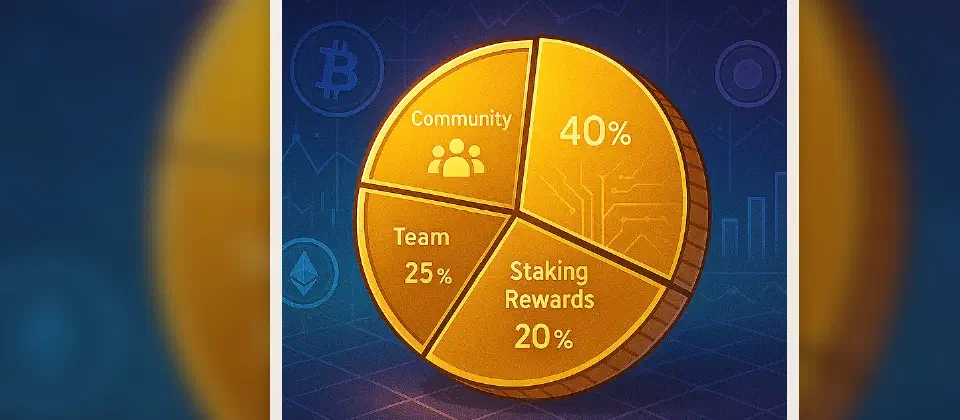
Tokenomics is one of the fastest ways to tell whether a crypto project is built for long-term use or short-term excitement.
The term sounds technical, but the idea is simple. Tokenomics is the economic design behind a token: how supply works, who owns what, how tokens enter circulation, what creates demand, and what incentives keep the system functioning. If those pieces are poorly designed, even a project with strong marketing can struggle. If they are well designed, the token has a much better chance of holding user interest and economic value over time.
From here, the goal is practical: understand why tokenomics matters and how to evaluate it without getting lost in jargon. If you are newer to crypto overall, start with Crypto for Beginners and How to Invest in Crypto first, then come back here when you are ready to judge projects more seriously.
What tokenomics actually means
Tokenomics is the economic rulebook of a token.
It covers questions such as:
- How many tokens exist?
- How quickly are new tokens released?
- Who got the earliest allocations?
- What can the token actually be used for?
- Does the design reward long-term participation or constant selling?
You can think of tokenomics as the financial architecture of a project. In traditional markets, investors look at revenue, margins, debt, dilution, and incentives. In crypto, tokenomics plays a similar role. It helps explain whether the system encourages sustainable demand or just short-lived speculation.
Why tokenomics matters so much
Many crypto projects fail for economic reasons, not technical ones.
A token can have a polished website, a persuasive narrative, and a vocal community, but still struggle because the supply schedule is too aggressive, insider allocations are too large, or the token has very little real use. That is why tokenomics matters. It helps explain whether the value model is coherent.
For investors and researchers, good tokenomics analysis can help answer three practical questions:
- Is this token likely to face heavy selling pressure?
- Does the token have a real role in the product or network?
- Are incentives aligned across users, developers, and early backers?
If you also want a broader research framework beyond token design, How to Thoroughly Research a Crypto Coin is the best companion page to this guide.
The main building blocks of tokenomics
1. Supply
Start with the simplest questions first:
- What is the total supply?
- What is the circulating supply?
- Is the token capped or inflationary?
Supply matters because price is only one part of valuation. A token with a tiny unit price can still be expensive if the supply is enormous. This is why pages like Crypto Market Cap Explained are so important alongside tokenomics analysis.
You should also look at whether new supply will keep entering the market for years. A token with heavy ongoing emissions may face constant selling pressure unless demand rises fast enough to absorb it.
2. Distribution
Who received the tokens in the beginning?
Look at the split among:
- team members
- early investors
- foundations or treasuries
- ecosystem incentives
- public users
Distribution matters because concentration creates risk. If insiders control a large share of supply, the market may worry about future selling or governance imbalance. A token does not need perfectly equal distribution to be credible, but it does need a structure users can understand and trust.
3. Vesting and unlocks
Allocation alone is not enough. Timing matters too.
If large allocations unlock quickly, the token may face heavy supply pressure even if the project itself is still growing. That is why vesting schedules are a core part of tokenomics analysis. Long, transparent vesting periods usually signal a more durable alignment than short lockups or vague disclosures.
4. Utility
A token should do something meaningful inside its ecosystem.
Common forms of utility include:
- paying network fees
- governance voting
- staking or securing the network
- collateral usage
- access to services or platform features
The key question is simple: does the system actually need the token? If the answer is weak, demand may also be weak.
5. Incentives
Every token economy is trying to shape behavior.
Projects use incentives to encourage:
- holding
- staking
- liquidity provision
- governance participation
- usage of the underlying product
Good incentives support real network activity. Bad incentives create short bursts of attention followed by outflows once rewards fade.
6. Burns, emissions, and supply controls
Many projects try to influence supply through burning or emission rules.
Burns can reduce circulating supply. Emissions can increase it. Neither is automatically good or bad. What matters is whether the mechanism fits the actual demand profile of the token. A burn narrative without real usage is weak. A high-emission model without sticky utility is also weak.
What good tokenomics looks like
Strong tokenomics usually shares a few qualities:
- supply rules are easy to explain
- insider allocations are visible and not excessively concentrated
- vesting is transparent
- the token has real utility
- incentives support long-term usage, not just speculation
- governance or treasury structures do not create obvious conflicts
That does not mean every strong token must look the same. Bitcoin, Ethereum, and many application tokens use very different models. What matters is internal coherence.
Common tokenomics red flags
These issues deserve extra caution:
- large insider allocations with weak disclosure
- fast unlock schedules
- vague claims about utility
- rewards that depend mainly on new buyer demand
- unsustainably high yields
- token burns used as marketing without meaningful usage
- governance that is technically decentralized but effectively controlled by insiders
If you are evaluating smaller or more speculative assets, this kind of discipline matters even more. Pages like How to Find Early Crypto Projects Without Chasing Hype are much more useful when paired with a strong tokenomics framework.
Tokenomics in real-world context
Tokenomics also helps explain why different crypto assets behave differently.
- Bitcoin’s value case leans heavily on scarcity and monetary credibility, which is why The Ultimate Bitcoin Guide for 2026 treats supply as such a central part of the BTC story.
- Ethereum’s economics involve fees, staking, and network usage, which makes its token model more linked to application activity.
- Stablecoins depend less on tokenomics in the classic sense and more on reserve quality, redemption design, and trust, which is why What Are Stablecoins? belongs in a neighboring but distinct cluster.
How to evaluate tokenomics step by step
If you want a simple process, use this checklist:
- Check total supply, circulating supply, and future emissions.
- Review allocations for insiders, investors, community, and treasury.
- Look up vesting and unlock schedules.
- Ask what real utility the token has.
- Examine whether rewards encourage durable behavior.
- Compare the token’s design with actual product usage.
- Decide whether the token’s economics make sense without hype.
That process is simple enough for beginners but still useful for more advanced readers.
Final takeaway
Tokenomics is not a side detail. It is one of the clearest ways to judge whether a crypto project deserves deeper attention.
A strong token design does not guarantee success, but a weak one can quietly undermine everything else. If you learn to read supply, distribution, utility, incentives, and unlock risk in a disciplined way, you will make better decisions across almost every part of crypto research.
The best next step is to pair this guide with How to Thoroughly Research a Crypto Coin and Crypto Market Cap Explained. Together, those pages form a much stronger foundation for evaluating any token you are considering.