
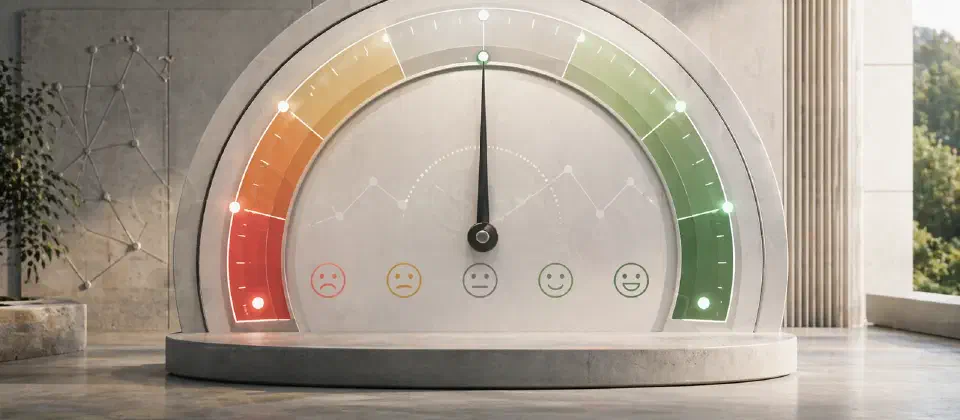
The crypto Fear and Greed Index is a sentiment indicator that tries to put a number on the emotional state of the market. It runs on a scale from 0 to 100. Readings near zero represent extreme fear — a market where participants are selling, panicking, or withdrawing. Readings near 100 represent extreme greed — a market where enthusiasm is running high, FOMO is building, and risk appetite has expanded. The number in the middle is somewhere between cautious and confident.
The index exists because human emotion reliably moves asset prices away from fair value in both directions. Fear causes overselling. Greed causes overbuying. A tool that tries to measure how intense that emotion is at any given moment has obvious appeal — not because it predicts what happens next, but because it provides a useful temperature reading of the market’s current psychology.
Understanding what the index actually measures, where its inputs come from, and why it is helpful without being reliable on its own is one of the more practical pieces of market literacy a crypto reader can develop.
How the index is built
The Fear and Greed Index is a composite indicator. No single signal determines the score. Instead, several different data sources are weighted together to produce the final reading.
Volatility accounts for a significant portion of the score in most versions of the index. The logic is that unusual spikes in price volatility — especially to the downside — are a symptom of fear. When the market is swinging more violently than usual, it often means participants are reacting emotionally rather than deliberately. High volatility tends to push the score toward fear.
Market momentum and volume measure recent price direction and trading activity relative to historical averages. A market that has been rising steadily with strong volume looks different from one where prices are falling and buyers are absent. Strong momentum and above-average volume contribute toward the greed side of the scale.
Social media sentiment tries to capture how positive or negative the tone of crypto conversation is across major platforms. The idea is that during greedy periods, everyone is talking excitedly about crypto. During fearful ones, the conversation turns negative, cautious, or goes quiet. Social sentiment data is inherently noisy, but large shifts in tone can be a meaningful signal.
Bitcoin dominance is used by some versions of the index as a proxy for risk appetite within crypto. When fear rises, traders often retreat into Bitcoin — perceived as the most liquid and defensible position within the asset class — at the expense of altcoins. Rising Bitcoin dominance can therefore indicate that money is consolidating defensively rather than rotating into higher-risk assets. Falling dominance, on the other hand, can suggest risk appetite is expanding. For a fuller explanation of how that works, see What Is Bitcoin Dominance and What Does It Really Tell You?.
Search trends capture changes in public interest via search volume data. Sudden spikes in searches for terms associated with buying or investing in crypto tend to signal growing public enthusiasm — a greed indicator. Spikes in searches related to crashes or selling suggest fear is spreading beyond active traders into a broader audience.
The weightings of these inputs vary depending on which version of the index you are looking at, and different providers build the calculation slightly differently. The specific number is less important than the general direction and the extremes it registers.
What fear and greed actually look like in crypto markets
Numbers on a scale are abstract until you connect them to what the market actually looks and feels like at different points.
When the index reads extreme fear — typically anything below 25 — the market is usually in a recognizable state. Prices have been falling. Headlines are negative. Social media is quiet or actively discouraging. Many participants have already sold or are reluctant to buy. The conversation has shifted from what to buy to whether crypto has a future at all. Liquidity can thin out because buyers are hesitant and sellers are motivated. These conditions often coincide with periods of genuine capitulation, where the last remaining weak holders exit their positions.
When the index reads extreme greed — typically anything above 75 — the environment looks almost exactly opposite. Prices have risen, sometimes sharply. People who rarely talk about crypto are asking how to buy. Social media is full of price predictions and celebration. Leverage in derivatives markets is often elevated. New participants are entering, often chasing recent gains rather than investing from conviction. The market moves easily because buyers are eager and sellers are patient — but that dynamic also means the market is increasingly dependent on continued new inflows to sustain the move.
The transition between these states matters as much as the states themselves. Fear can lift quickly on a single piece of positive news. Greed can turn to fear almost instantly when a catalyst breaks the momentum. Neither extreme is particularly stable, which is both why the index moves and why acting on a single reading is unreliable.
Why traders and investors pay attention
The most common rationale for watching the Fear and Greed Index is contrarian in nature.
The underlying argument comes from behavioral finance: markets overshoot because human emotion is not calibrated to the present environment. Sellers in extreme fear conditions often sell past fair value because they are responding to pain and uncertainty rather than a calculated view of what assets are worth. Buyers in extreme greed conditions often buy past fair value because they are responding to social pressure and the fear of missing gains rather than fundamentals.
If that is true, then extreme fear — especially sustained extreme fear — can represent a more favorable entry environment than the emotional tone of the moment would suggest. And extreme greed can represent a more dangerous environment than the current price momentum implies.
Looking at Bitcoin’s history, periods of sustained extreme fear have often overlapped with ranges that, in hindsight, offered relatively favorable long-term entry points. Periods of sustained extreme greed have sometimes — though not reliably — preceded corrections.
That pattern is the reason experienced market participants watch the index. Not because it signals exact reversals, but because it adds context. Buying when everyone is fearful requires a particular kind of conviction. Knowing that sentiment is historically extreme can be one input in building that conviction.
Where the index fails and why it cannot stand alone
The usefulness of the Fear and Greed Index is real, but it is also constrained in ways that are easy to underestimate.
The most fundamental limitation is that extreme readings can persist. Fear can hold at single-digit levels for weeks or months in a genuine bear market. Greed can remain elevated for extended periods in a strong bull cycle. The index tells you the current emotional temperature, not how long that temperature will last or when it will change. Acting as though an extreme reading immediately precedes a reversal is a misreading of what the number represents.
The second limitation is that the same score can mean very different things at different price levels. Extreme fear at $65,000 Bitcoin is a different market than extreme fear at $20,000 Bitcoin, even if the index shows an identical number. The composition of who is fearful, why they are fearful, and what a reversal would require is fundamentally different. The index strips out that context entirely.
Third, the inputs are relatively blunt proxies. Social media sentiment is noisy. Search trend data captures casual interest more than informed positioning. Volatility readings can be elevated for structural reasons that have nothing to do with emotional selling. When you combine blunt proxies, you get a number that reflects broad market mood in a rough way — useful for orientation, not reliable for precision.
Fourth, the index does not account for the macro environment. Whether the Federal Reserve is raising or cutting rates, whether the dollar is strengthening or weakening, whether liquidity conditions broadly are tightening or easing — none of that is in the Fear and Greed calculation. A reading of extreme fear in a period of improving macro conditions carries different forward implications than the same reading in a deteriorating macro environment. Separating those requires information the index does not contain.
For a more rigorous reading of market conditions that goes beyond surface sentiment, How to Read Bitcoin On-Chain Data Without Getting Misled explains how to layer on-chain signals alongside price action and macro context. The Fear and Greed Index and on-chain data are not substitutes — they describe different things about the same market.
Common mistakes beginners make
The most common mistake is treating a single index reading as an actionable buy or sell signal. “The index is at 10, which means extreme fear — time to buy” is not an analysis. It is a heuristic applied without any of the contextual checks that would make it meaningful.
A related mistake is confusing the index with a prediction. The Fear and Greed Index describes how the market feels right now. It does not have strong predictive power on its own for what the market will do next week or next month. Studies that show a correlation between extreme fear and future returns are working with historical averages across long time periods — not with reliable short-term signals.
Beginners also frequently interpret the index as an endorsement of action. Extreme greed is not a sell signal in the sense that it tells you to reduce exposure immediately. It is a context signal in the sense that it tells you the market may be pricing in optimism that is hard to sustain. Whether that turns into a correction depends on factors that are not inside the index.
The final mistake is using the index without a view of where you are in the broader cycle. Sentiment during a sustained bull market behaves differently from sentiment during a bear market or a range-bound consolidation period. Contextualizing the index reading against the broader multi-year picture — whether we are in an accumulation phase, a markup phase, or a distribution phase — substantially changes what the reading implies. The Bitcoin 4-Year Cycle guide covers how those phases have historically looked and why sentiment extremes tend to cluster at specific points within them.
How to use it more intelligently
Used carefully, the Fear and Greed Index is a lightweight, accessible way to calibrate how emotional the market currently is before making a decision. The key word is “calibrate.” It should inform your interpretation of other signals, not replace them.
A practical approach: when the index is at extreme fear, it raises the question of whether the current environment represents genuine capitulation or simply the early phase of a longer decline. Checking whether on-chain long-term holder behavior supports capitulation, whether macro conditions are improving or deteriorating, and whether selling pressure is concentrated in specific assets or broad across the market adds the context the index cannot provide on its own.
Similarly, when the index reads extreme greed, the useful question is not “should I sell?” but “what would need to go wrong for this sentiment to reverse, and how quickly could it happen?” Leverage levels in derivatives, the concentration of recent gains in a small number of assets, and the sustainability of the inflows supporting the move are the right places to look.
Changes in the index over time are more informative than a single reading. A market moving from 15 to 40 over two weeks signals something different from one that has been stuck at 15 for six weeks. The direction and persistence of the reading add context the spot number alone cannot provide.
For readers who want to build a more complete toolkit for evaluating crypto markets — beyond sentiment alone — How to Research a Crypto Coin Properly covers the broader evaluation process, and What Are Altcoins? helps explain how sentiment behavior differs between Bitcoin and the wider altcoin market, where Fear and Greed dynamics can be amplified significantly.
Readers new to investing in crypto more broadly should also see Crypto for Beginners, which situates sentiment tools within the larger picture of how to approach the asset class.
The index measures mood, not direction
The Fear and Greed Index is best understood as a thermometer, not a compass. It tells you how hot or cold the emotional climate is. It does not tell you where the market is going.
When the temperature is extremely cold — when panic and pessimism are elevated — it raises the probability that the market has already priced in a lot of bad news. When the temperature is extremely hot — when optimism and risk appetite are high — it raises the probability that the market has already priced in a lot of good news.
Neither of those observations is a trade. Both are context. And good context, combined with a clear view of the macro environment, the cycle position, and the on-chain structure of the market, is what separates informed market participants from ones who are simply reacting to headlines or numbers.
The index is most useful to readers who understand its limitations clearly enough to resist using it as a shortcut.