
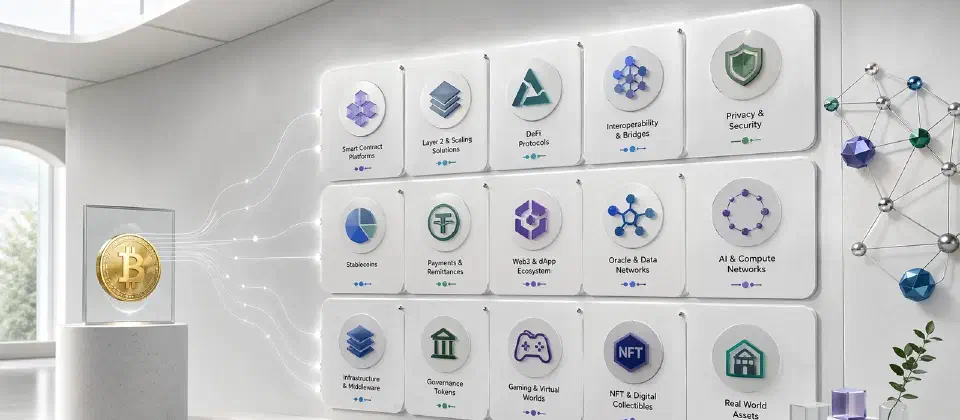
“Altcoin” is short for “alternative coin” — any cryptocurrency that is not Bitcoin. That simple definition is useful for conversation, but weak for research.
The word groups very different things together: Ethereum-style smart-contract networks, Layer 2 tokens, DeFi governance assets, stablecoins, exchange tokens, payment tokens, infrastructure projects, meme assets, and small speculative tokens with almost no real liquidity. A token used to pay network fees is not the same thing as a meme coin. A stablecoin is not the same thing as a governance token. A useful app does not automatically make its token valuable.
This guide is meant to help beginners stop treating “altcoin” as one category. The better question is: what function does this asset serve, what demand does the token capture, and how much risk is hidden behind the narrative?
Why the term exists
Bitcoin launched in 2009 as the first cryptocurrency. For several years, it was essentially the only one. When other developers began building alternative blockchains and tokens, the community needed a shorthand for everything else. “Altcoin” filled that role.
The term has always been a catch-all rather than a technical description. Some people use it more narrowly, excluding Ethereum because of its scale and central role in decentralized finance. That usage is less common but worth knowing. In most conversations, “altcoin” means any crypto asset that is not Bitcoin.
How altcoins differ from Bitcoin
Bitcoin was designed for one primary purpose: a decentralized, fixed-supply digital currency. Its rule set is deliberately simple and conservative. There is a hard cap of 21 million coins, a predictable issuance schedule, and a security model built around proof-of-work mining. Most changes to Bitcoin move slowly, by design.
Most altcoins were built to do something different or something more. That is both their appeal and a source of their risk.
Ethereum extended the blockchain model to support programmable smart contracts, enabling decentralized applications, lending markets, and tokenized assets. Other platforms followed with different architectures and different trade-offs between speed, cost, and decentralization.
Beyond technical differences, Bitcoin has the longest track record, the deepest liquidity, the broadest institutional familiarity, and the clearest regulatory standing in most major jurisdictions. That context matters when comparing how much risk Bitcoin carries versus how much an altcoin carries.
If you want the Bitcoin-specific foundation first, Bitcoin Guide is the strongest starting point on this site.
The main categories of altcoins
Altcoins are not a single thing. They are better understood by category, because the risk profile, the valuation framework, and the research process differ significantly across them.
Layer 1 smart-contract platforms
These are blockchains that support programmable applications. Ethereum is the largest and most established. Others — Solana, BNB Chain, Avalanche, Cardano — compete on different versions of the same trade-off between transaction speed, cost, decentralization, and developer tooling. Their native tokens are used to pay network fees and, in some cases, to participate in governance. These platforms have genuine economic activity behind them, though their token values still move with broader market sentiment.
For a deeper look at how these networks are structured, Blockchain Basics and the Layer 1 and Layer 2 explainer cover the technical side.
Layer 2 and scaling tokens
Layer 2 networks process activity around a larger base chain, most often Ethereum, with the goal of improving transaction speed and cost. Their tokens may be used for governance, incentives, or network economics, but the token value case is not always as direct as the usage story. A Layer 2 can process real activity while its token still struggles if fees do not accrue clearly, supply unlocks are heavy, or governance rights have limited economic value.
Stablecoins
Stablecoins are designed not to move. They aim to hold a fixed value — usually one U.S. dollar — and are primarily used for trading, transfers, and DeFi activity. Because they are pegged, they sit in a different risk category from other altcoins. However, the mechanics behind the peg (fiat-backed, crypto-collateralized, or algorithmic) matter significantly. Not all stablecoins behave identically under stress. Stablecoins Explained covers this category in detail.
DeFi and governance tokens
Decentralized finance protocols — lending markets, decentralized exchanges, yield platforms — often issue their own tokens. These can serve multiple roles: governance rights over protocol decisions, a share of fee revenue, or liquidity incentives. Their value is typically tied to the usage and growth of the protocol behind them. Most DeFi tokens are relatively small-cap and highly sensitive to market cycles. When activity slows, token value often falls sharply.
Exchange tokens
Large crypto exchanges issue their own tokens that typically offer fee discounts, access to launchpad features, or platform-specific benefits. BNB (Binance) is the most prominent example. Their value is linked partly to exchange activity and partly to how the issuing exchange manages the token over time.
Meme coins
Meme coins are driven by community attention and internet culture rather than technical utility or fundamental value. Dogecoin and Shiba Inu are the oldest examples. Their value depends heavily on sentiment, social media momentum, and sometimes celebrity attention. They can move dramatically in both directions and often do. Meme Coins Explained covers this category and its risk profile more thoroughly.
Infrastructure and utility tokens
Some altcoins are tied to specific infrastructure services: decentralized storage networks, oracle providers, cross-chain bridges, identity protocols, or decentralized computing platforms. Their value is theoretically tied to adoption of the service behind them. In practice, these tokens often trade like speculative assets regardless of whether the underlying technology is performing well.
Staking and validator tokens
Proof-of-stake networks use tokens to help secure the chain. Holders may stake directly, delegate to validators, or use liquid staking products, depending on the network. The beginner risk is assuming staking yield makes an asset safe. Staking can add protocol risk, validator risk, lockup risk, slashing risk, and price risk at the same time.
Payment and application tokens
Some tokens support payment apps, creator platforms, gaming economies, social products, or other consumer applications. These can be useful, but beginners should separate user activity from token value. A product can attract users while the token still suffers from weak demand, inflation, poor liquidity, or unclear legal treatment.
Narrative, usage, liquidity, and token value
Altcoin mistakes often start when readers mix four different signals together.
- Narrative: What the market is excited about right now.
- Usage: Whether people actually use the network, app, or protocol.
- Liquidity: Whether there is enough depth to enter and exit without large slippage.
- Token value capture: Whether the token benefits directly from the activity around it.
Those signals do not always point in the same direction. A token can have a strong narrative and weak usage. A network can have real usage and a poor token design. A project can have high trading volume for a few weeks and then lose liquidity when the story fades.
This is why altcoin research needs more than a chart. It needs the supply work from What Is Tokenomics?, the sizing discipline from How to Invest in Crypto, and the research checklist in How to Research a Crypto Coin Properly.
Why investors are drawn to altcoins
The most common reason is the belief that smaller or newer assets offer higher upside than Bitcoin.
That belief is sometimes correct and sometimes not. In strong bull markets, many altcoins rise faster than Bitcoin. The flip side is that in bear markets, they also fall faster — often much faster. The historical pattern is that most altcoins underperform Bitcoin over full market cycles once the full drawdown is accounted for.
A more reasoned motivation is exposure to a specific technology or sector: smart contract infrastructure, DeFi protocols, or decentralized applications. This approach can make sense, but it still requires a clear view of whether the token actually captures the economic value generated by the sector. Many useful protocols have tokens whose value does not track the protocol’s growth in any predictable way.
The third reason is speculation. Many altcoin buyers are not making long-term bets. They are looking for fast moves driven by attention cycles. That approach is not inherently wrong if the risks are clearly understood, but it is often mistaken for investing.
Why altcoins carry more risk than Bitcoin
The most important factor is market position. Bitcoin has the broadest recognition, the deepest liquidity, and the strongest institutional familiarity. In risk-off periods, capital tends to flow toward Bitcoin and away from smaller altcoins. That pattern has been consistent across multiple market cycles.
Most altcoins also have smaller float, which means fewer buyers or sellers can move the price sharply. Liquidity can disappear quickly in smaller-cap assets.
The other risk is project risk. Altcoins depend on teams, roadmaps, and continued development. Projects can stall, developers can exit, pivots can destroy token value, and competitive dynamics can shift quickly. Bitcoin has no central team and no roadmap in the traditional sense.
Regulatory risk is also higher for many altcoins. Bitcoin has clearer legal treatment in most major jurisdictions. Many altcoin tokens — particularly those issued in ways that resemble securities offerings — face a more uncertain regulatory environment that can change rapidly.
Common mistakes beginners make
Buying a low unit price as a signal of value. A token priced at a fraction of a cent can still be overvalued if the total supply is enormous. Market cap matters more than price per token. Crypto Market Cap Explained makes this point clearly and is worth reading before you buy any token based on price alone.
Treating all altcoins as interchangeable. A smart-contract platform with years of real usage is not in the same risk category as a meme coin launched last week. Grouping them together leads to mismatched expectations and poor portfolio construction.
Chasing performance after a sharp move. Altcoins that have already risen 300% in two weeks are at peak speculative attention, not at a discount. Buying into momentum without a framework is one of the most predictable ways to hold the worst part of a move.
Overallocating because the narrative is compelling. Strong stories are everywhere in crypto. The right position size for a speculative altcoin is usually much smaller than the narrative suggests. A compelling whitepaper is not a reason to size up.
Ignoring how token supply actually works. Understanding how much supply exists, how much is locked, who holds it, and what unlock schedules look like matters before buying. A low circulating supply can artificially inflate apparent market cap and create sharp dilution when tokens unlock. What Is Tokenomics? is the right framework to read before buying any token.
Assuming a token is equity. Most tokens do not give legal ownership of a company, a claim on assets, or shareholder rights. Some provide governance, usage, incentives, or access. Those are different things, and the difference matters when valuing the asset.
Mistaking a category for a thesis. Saying “I like data-infrastructure tokens,” “I like gaming tokens,” or “I like Layer 2s” is not a research conclusion. Each asset still needs its own supply, liquidity, token value, team, and regulatory review.
How to evaluate an altcoin more intelligently
Start with the simplest question: what does the project actually do, and does it need a token to do it?
If the answer is no — if the product could work without the token, or if the token exists only to raise money — that is worth pausing on.
From there, a disciplined research process covers:
- Market cap and fully diluted valuation: Is the current price reasonable relative to what the project would be worth at full supply?
- Token utility and demand drivers: Is there a reason people need the token beyond speculation? Does using the platform require holding it?
- Use case versus token value: Does real usage create direct demand for the token, or is the token only loosely connected to the product?
- Liquidity: Can you exit the position at a meaningful size without significant slippage?
- Team and development activity: Is the team identifiable, accountable, and actively building?
- Supply mechanics: When do large unlocks happen? Who holds the majority of supply?
- Competitive positioning: Does this project have a durable reason to exist alongside ten similar alternatives?
How to Research a Crypto Coin Properly covers the full research process and is the strongest companion page for applying this framework in practice.
A practical starting point
Altcoins represent the broadest and most experimental layer of the crypto market. Some of that experimentation has produced genuinely useful infrastructure. A much larger share produces projects that fail, fade, or never deliver on their stated purpose. The ratio has been consistently unfavorable for most buyers who did not do serious research.
For beginners, the most useful posture is neither blanket skepticism nor blanket enthusiasm. Altcoins are a category that requires real research, careful sizing, and realistic expectations about what the majority of assets in this space actually do over time.
Understand what kind of altcoin you are looking at before buying it. Know how it differs from Bitcoin, why the risk profile is higher, and whether the token design actually supports the story being told about it.
The broader investing foundation starts with Crypto for Beginners and How to Invest in Crypto. The research process is in How to Research a Crypto Coin Properly. The Bitcoin comparison sits in Bitcoin Guide.
Altcoins can play a legitimate role in a thoughtful crypto portfolio. The key word is thoughtful.
One metric worth understanding as your altcoin research deepens is Bitcoin dominance — the share of total crypto market value that belongs to Bitcoin. It is often used to track capital rotation between Bitcoin and the broader altcoin market, but it has real limits and is widely misread. What Is Bitcoin Dominance? explains how the metric works and where it can mislead.