
What the Bitcoin Halving Actually Is
The Bitcoin halving is a built-in event that cuts the block subsidy in half. The block subsidy is the amount of new bitcoin created and paid to miners when they add a valid block to the blockchain.
That is the core idea. The halving does not split your holdings in half. It does not reduce the number of bitcoin already in circulation. It does not change Bitcoin’s maximum supply. It only reduces the rate at which new bitcoin enters the market.
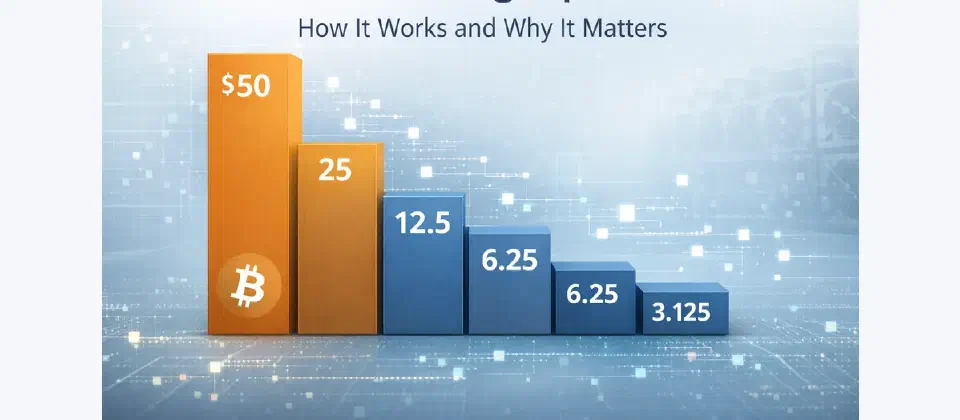
In practical terms, Bitcoin started with a 50 BTC block subsidy. It then dropped to 25 BTC, then 12.5 BTC, then 6.25 BTC, and after the 2024 halving it moved to 3.125 BTC per block. At roughly 144 blocks per day, that means new issuance fell from about 900 BTC per day to about 450 BTC per day.
If you are new to crypto overall, it helps to read Crypto for Beginners: Everything You Need to Know Before You Start and The Ultimate Bitcoin Guide for 2026 first. The halving makes more sense once you already understand what Bitcoin is trying to be.
Why Bitcoin Has Halvings
Bitcoin was designed to have a predictable supply schedule from the start. New coins are not issued whenever demand rises, and there is no central authority that can decide to create more on short notice.
The halving is part of that design. It slows issuance over time and helps Bitcoin approach its long-term supply cap gradually rather than all at once. That gives the network a clear monetary rule set:
- early on, higher issuance helped distribute coins and reward miners for securing a young network
- over time, issuance falls, making the asset scarcer in flow terms
- in the very long run, miner compensation is expected to rely more on transaction fees than on newly created coins
This is one reason Bitcoin is often discussed differently from fiat currencies and from many other crypto assets. Its issuance policy is visible, rule-based, and not meant to respond to short-term politics or discretionary policy decisions. If you want the broader technology context behind that design, Blockchain Basics: A Beginner’s Guide to the Tech Behind Crypto is the best companion explainer.
How Often the Halving Happens
Bitcoin halves every 210,000 blocks, which works out to roughly once every four years. It is tied to block production, not to a calendar date, so no one can know the exact day years in advance. The estimate moves because blocks do not arrive at perfectly fixed intervals.
That point matters because people often speak about halving years as if the event lands on a guaranteed date. It does not. The rule is block-based.
The broader pattern, though, is easy to understand:
- block 0 era: 50 BTC
- first halving: 25 BTC
- second halving: 12.5 BTC
- third halving: 6.25 BTC
- fourth halving in 2024: 3.125 BTC
The next halving is expected around 2028 if the network continues operating normally.
How the Block Reward Changes Over Time
People often use the phrase “block reward” as a shortcut, but it helps to separate two pieces:
- the block subsidy, which is newly issued bitcoin
- transaction fees, which are paid by users who want their transactions included in a block
Miners receive both together. The halving affects the subsidy, not the fees.
That distinction is important because it explains two things at once. First, Bitcoin’s new supply becomes harder to grow over time. Second, miner revenue does not simply vanish after each halving, because fees still exist. What changes is the balance. After each halving, the guaranteed new-coin portion of miner revenue is lower, so miners become more sensitive to Bitcoin’s price, fee demand, hardware efficiency, and electricity cost.
That is why the halving sits at the center of Bitcoin’s economic design. It connects monetary policy, network security, and mining economics in one rule.
How Halving Affects Bitcoin’s Supply Issuance
The cleanest way to think about halving is as a reduction in new supply flow, not as a change to existing supply.
After a halving:
- the stock of bitcoin already in circulation stays the same
- the pace of new issuance slows down
- the annual inflation rate of Bitcoin’s supply falls
This is where many beginners get confused. They hear “halving” and assume the total supply gets cut in half. That is not what happens. The total supply cap remains the same. What changes is how quickly the remaining bitcoin is issued.
For readers trying to place halving inside a broader economic framework, What Is Tokenomics? How Crypto Value Is Designed is especially useful. Bitcoin is simpler than most token systems, but its halving schedule is still a form of tokenomics: it defines issuance, scarcity, and incentives in advance.
How Halving Affects Miners
The halving is one of the most important events for miners because it cuts the subsidy side of their revenue overnight.
If fees stay flat and Bitcoin’s price does not rise enough to offset the change, miners earn less revenue per block than before. That puts pressure on operators with weak margins, older machines, high electricity costs, or heavy debt.
In practice, the effect often shows up in a few ways:
- less efficient miners may shut down or become unprofitable
- stronger operators focus even more on energy cost and fleet efficiency
- mining economics become more sensitive to fee spikes and market conditions
- the industry tends to pay closer attention to consolidation, treasury management, and hardware upgrades
If you want the deeper operational side, Bitcoin Mining Explained: How It Works and What It Costs is the natural next read. It covers why hashrate, difficulty, ASIC efficiency, and power pricing matter so much after a halving. For a more focused explanation of the infrastructure metrics themselves, Bitcoin Hashrate and Difficulty Explained for Beginners fills in that part of the picture.
One point beginners often miss is that halving does not make mining easier just because fewer coins are being issued. In fact, it often makes the business tougher. Revenue per block falls, while competition, difficulty, and operating costs still matter as much as ever.
Why People Pay So Much Attention to Halvings
People follow halvings because they are one of the rare events in finance where the supply-side rule is known in advance and enforced by code.
That does not mean the market reacts in a simple or immediate way. It means investors, miners, analysts, and long-term Bitcoin holders all know that future issuance is stepping down on a predictable path.
Halvings matter most for three reasons:
- they reinforce Bitcoin’s scarcity narrative
- they change miner economics directly
- they influence how people think about future sell pressure from newly issued coins
That last point is often simplified too much. Lower issuance can matter over time, but the market still depends on demand, liquidity, macro conditions, regulation, ETF flows, leverage, and investor psychology. If you want a calmer framework for how to think about exposure rather than headlines, How to Invest in Crypto: A Practical Beginner Roadmap is a better guide than chasing cycle myths.
What the Halving Does Not Guarantee for Price
This is where the most common myths appear.
The halving does not guarantee that Bitcoin’s price will rise immediately. It does not guarantee a bull market on a fixed schedule. It does not guarantee that every post-halving period will look like the last one.
There are good reasons people pay attention to supply reduction, but price is still shaped by a larger set of forces:
- demand for Bitcoin can rise or fall
- broader risk appetite can change
- liquidity conditions can tighten
- miner selling behavior can shift
- leveraged speculation can amplify moves in either direction
The rational view is that halving changes one important variable in Bitcoin’s long-term supply picture. It does not control the entire market by itself.
That is why beginners should be careful with simplistic statements like “halving means price must double” or “the cycle always repeats the same way.” Markets do not reward slogans for long.
Common Halving Myths and Misunderstandings
“The halving cuts Bitcoin’s total supply in half”
False. It cuts the block subsidy in half. Existing supply does not disappear.
“The halving creates scarcity overnight”
Not exactly. Bitcoin is already scarce by design. The halving changes the rate of new issuance, which affects the flow of new supply, not the stock already held by the market.
“Price always surges right after the halving”
Not guaranteed. Markets can move before the event, after the event, or in ways that reflect broader macro conditions more than a simple calendar narrative.
“Miners just earn half as much forever”
Not necessarily. Their revenue also depends on transaction fees, Bitcoin’s price, network difficulty, and operational efficiency.
“Once halvings matter less, Bitcoin stops working”
No. Bitcoin was always designed to reduce subsidy dependence over time. The open question is not whether the rule exists, but how the long-term balance between subsidy, fees, and security budget evolves.
For readers building a better research habit, How to Research a Crypto Coin Properly helps cut through this kind of narrative confusion. The same principle applies here: understand the mechanism first, then judge the market story around it.
Readers who want to understand how halving events fit inside a broader multi-year market model should continue with The Bitcoin 4-Year Cycle, which explains the cycle phases, why the framework became popular, and where it can fail.
How Beginners Should Think About the Halving
The most useful beginner mindset is to treat the halving as a structural feature of Bitcoin, not as a trading signal on its own.
A few practical rules help:
- understand the difference between supply flow and price
- remember that miner economics and investor expectations are not the same thing
- focus on Bitcoin’s full market context, not one event in isolation
- avoid cycle folklore presented as certainty
It also helps to keep valuation language disciplined. A lower issuance rate can support a long-term scarcity case, but it does not tell you whether Bitcoin is overheated or underpriced at any given moment. For that, broader context still matters, including market size, positioning, and expectations. Crypto Market Cap Explained: How to Evaluate Coins Properly can help newer readers think more clearly about valuation language instead of relying on simplistic supply narratives.
What to understand next
The Bitcoin halving matters because it is one of the clearest examples of Bitcoin’s rules in action. It reduces new issuance, reshapes miner economics, and reinforces the idea that Bitcoin follows a predetermined supply path rather than a discretionary one.
But the most important takeaway is what the halving does not do. It does not hand the market a guaranteed price script. It does not remove risk. It does not replace the need for patient research.
If you understand the halving as part of Bitcoin’s monetary design, you are already thinking about the asset more clearly than many market participants. From here, the best next step is to connect that mechanism to the bigger picture: Bitcoin basics, mining economics, blockchain design, and disciplined research.