
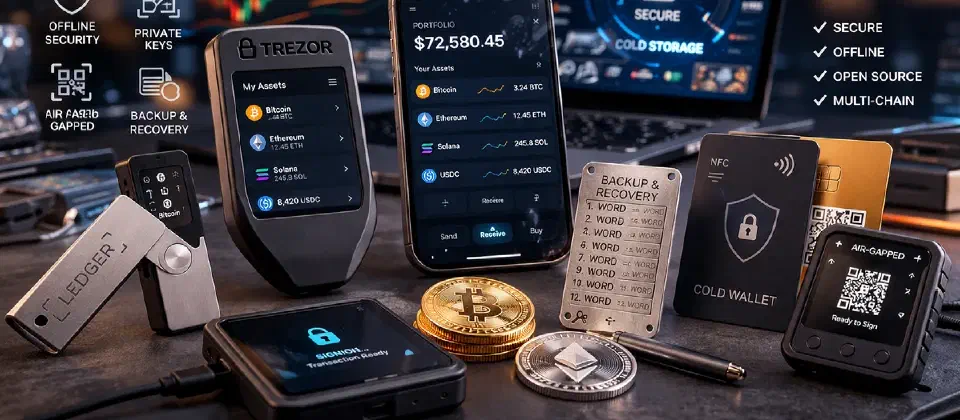
Why cold wallets still matter in 2026
Cold wallets remain one of the clearest security upgrades a crypto user can make.
This is the main overall cold-wallet guide in the Knowledge library. It covers premium, mid-range, and practical mainstream options without making price the first filter. If you are choosing a device for meaningful long-term holdings, the priority is security model, recovery design, supported assets, transaction clarity, software ecosystem, and whether the workflow fits the way you actually use crypto.
That has not changed. What has changed is the environment around cold wallets. More users are active across multiple chains, browser wallets, NFT apps, staking tools, and DeFi protocols. That creates more convenience, but it also creates more chances to approve the wrong transaction, trust the wrong app, or keep too much value in a hot wallet for too long.
A cold wallet does not eliminate every risk. It does keep your signing keys offline, which reduces exposure to many of the most common remote attack paths. This page is the main hardware-wallet buyer’s guide in the Knowledge library, so it works best after you understand the basics of custody and before you decide which device fits your own habits. If you are still learning the basics of custody, read The Ultimate Bitcoin Guide for 2026, How to Invest in Crypto, and Crypto for Beginners: Everything You Need to Know Before You Start alongside this page.
Why many users still choose cold wallets over exchanges
The strongest reason is control.
When assets stay on an exchange, you are depending on someone else’s systems, policies, liquidity and operational stability. A cold wallet changes that by giving you direct control over the keys that authorize access to your assets.
That matters most during moments when platforms stop behaving normally.
Common reasons users still prefer cold storage for long-term holdings include:
- exchange hack risk
- withdrawal delays or freezes
- policy changes and jurisdictional restrictions
- counterparty failure
- the need to separate trading funds from long-term holdings
That does not mean every coin must sit in cold storage all the time. It means long-term holdings deserve a custody plan, not just a default app setting.
What makes a good cold wallet now
The best cold wallets in 2026 are not all solving the same problem.
Some are best for broad asset support. Some are best for simpler mobile use. Others are stronger for recovery design, transaction review, or air-gapped workflows. That is why the best choice depends on how you actually use crypto.
When comparing devices, focus on:
- security design
- recovery model
- transaction clarity
- asset support
- software ecosystem
- how realistic the workflow is for your habits
That last point matters more than many buyers admit. A wallet that is theoretically excellent can still be the wrong choice if it is too frustrating for you to use properly.
Before buying any device, verify the current model, firmware support, regional availability, and official sales channel yourself. Hardware-wallet product lines change, counterfeit devices exist, and the safest purchase is usually through the manufacturer or an authorized reseller rather than an unfamiliar marketplace listing.
The best overall and premium cold wallets to consider in 2026
Ledger Flex
Ledger Flex is one of the strongest all-around choices because it combines broad asset support, a mature software ecosystem, and a larger screen that makes transaction review much easier than on older hardware wallets.
That screen matters. In modern crypto use, you are often reviewing token approvals, contract interactions, and more complex signing prompts than a simple transfer. Better transaction clarity is a real security feature.
Best for: users who want one versatile mainstream hardware wallet for a broad portfolio.
Trezor Safe 5
Trezor Safe 5 is one of the best premium options for users who care about transparency, straightforward design, and a stronger open-source identity.
Its appeal is not just security. It also feels understandable, which matters in self-custody. A device is more useful when you trust your own ability to use it correctly.
Best for: users who want a premium cold wallet with a cleaner, open-source-leaning feel.
Tangem
Tangem remains one of the simplest cold-storage options for beginners and mobile-first users.
Its NFC-card approach feels very different from traditional hardware wallets. That is a feature, not a flaw, for people who want less setup friction and a lower chance of mishandling a more complex device.
Best for: beginners and mobile-first users who want the easiest cold-wallet experience.
Cypherock X1
Cypherock X1 stands out because it addresses a major self-custody weakness: backup concentration.
Instead of relying on a single recovery phrase in one place, it uses a distributed recovery model built around separate hardware elements. That makes it especially relevant for users who care deeply about reducing single-point-of-failure risk.
Best for: advanced users focused on stronger recovery design.
Keystone 3 Pro
Keystone 3 Pro is a strong fit for users who prefer more isolated signing and a more deliberate workflow.
It is not the smoothest device for every user, but that is not really the point. Its appeal is greater separation from internet-connected devices and a setup philosophy that prioritizes security posture over convenience.
Best for: users who want an air-gapped-style security approach.
SafePal X1
SafePal X1 remains relevant because many users need stronger security without jumping straight to the premium end of the market.
That makes it an important practical option. The best entry-level cold wallet is not simply the cheapest one. It is the one that is affordable, usable, and good enough that you will actually use it instead of postponing self-custody indefinitely.
Best for: cost-conscious users who still want a capable multi-chain cold wallet.
Which cold wallet fits which type of user
If you want the short version:
- Best overall for most users: Ledger Flex
- Best premium open-source-leaning option: Trezor Safe 5
- Best for beginners and mobile-first users: Tangem
- Best for backup design: Cypherock X1
- Best for isolation-first setups: Keystone 3 Pro
- Best lower-cost mainstream option: SafePal X1
If budget is your biggest constraint, continue with Best Budget Cold Wallets in 2026, which focuses specifically on cheaper safe options, lower-cost trade-offs, and what buyers should not sacrifice just to save money.
Common mistakes when choosing a cold wallet
The most common mistakes are not technical. They are behavioral.
Watch for:
- buying based only on brand familiarity
- ignoring the recovery process
- choosing a wallet that does not fit your asset mix
- underestimating how important transaction review is
- setting up the wallet before planning backup storage
- assuming cold storage is unnecessary because the exchange “feels safe”
That last mistake is one reason this page should connect naturally to the site’s broader beginner-security cluster rather than stand alone. If you are deciding between convenience, self-custody, and platform exposure, What Are Stablecoins? and The Ultimate Bitcoin Guide for 2026 are useful companion reads because custody decisions change depending on what you actually hold.
Bottom line
The best overall cold wallet in 2026 is not just the device with the strongest marketing or the longest feature list. It is the wallet whose security model, recovery setup, supported assets, ecosystem, and day-to-day workflow best match the way you actually hold crypto.
Cold storage is not about perfection. It is about reducing avoidable risk. If you choose a wallet you can use confidently and back up properly, you are already far ahead of the average user.